

-
1 déclencheur à maximum de courant à retard indépendant
Максимальное реле или максимальный расцепитель тока с независимой выдержкой времени
Максимальное реле или максимальный расцепитель тока, срабатывающие с определенной выдержкой времени, которая может регулироваться, но не зависит от величины сверхтока.
[ ГОСТ Р 50030. 1-2000 ( МЭК 60947-1-99)]EN
definite time-delay over-current release
an over-current release which operates with a definite time-delay, which may be adjustable, but is independent of the value of the over-current
[IEV number 441-16-34]FR
déclencheur à maximum de courant à retard indépendant
déclencheur à maximum de courant qui fonctionne avec un retard défini qui peut être réglable mais est indépendant de la valeur de la surintensité.
[IEV number 441-16-34]Параллельные тексты EN-RU Protection against overload may be provided on both the high-voltage side and the low-voltage side, depending on the transformer power. For low-power transformers the protection should be positioned on the low-voltage side, while for high-power transformers the protection should be provided on the high-voltage side. Protection against overloads on the HV side is provided using HV circuit breakers associated with maximum-current protections in constant time or independent time.
[Legrand]В зависимости от мощности трансформатора, защита от перегрузки выполняется на стороне высшего или низшего напряжения. Мощные трансформаторы защищают со стороны электросети, а маломощные – со стороны нагрузки. Защита от перегрузки на стороне высшего напряжения осуществляется высоковольтным автоматическим выключателем с максимальными расцепителями тока с независимой выдержкой времени.
[Перевод Интент]
Недопустимые, нерекомендуемые
Тематики
- выключатель автоматический
- расцепитель, тепловое реле
- реле электрическое
Классификация
>>>EN
DE
FR
Франко-русский словарь нормативно-технической терминологии > déclencheur à maximum de courant à retard indépendant
-
2 protection à maximum de tension
защита от повышения напряжения
Защита, предназначенная срабатывать, когда напряжение в энергосистеме превышает заранее установленное значение.
[Разработка типовых структурных схем микропроцессорных устройств РЗА на объектах ОАО "ФКС ЕЭС". Пояснительная записка. Новосибирск 2006 г.]EN
overvoltage protection
protection intended to operate when the power system voltage is in excess of a predetermined value
[IEV ref 448-14-32]FR
protection à maximum de tension
protection destinée à fonctionner lorsque la tension du réseau d'énergie dépasse une valeur prédéterminée
[IEV ref 448-14-32]Тематики
EN
DE
- Maximalspannungsschutz, m, (CH)
- Überspannungsschutz, m
FR
Франко-русский словарь нормативно-технической терминологии > protection à maximum de tension
-
3 puissance disponible d’une centrale
располагаемая мощность агрегата (электростанции)
Установленная мощность генерирующего агрегата (электростанции), за вычетом ограничений его мощности.
[ ГОСТ 19431-84]EN
available capacity of a unit
the maximum power at which a unit can be operated continuously under the prevailing conditions
Note – This power may be gross or net.
[IEV ref 602-03-11]
available capacity of a power station
the maximum power at which a power station can be operated continuously under the prevailing conditions
Note – This power may be gross or net.
[IEV ref 602-03-12]FR
puissance disponible d'une tranche
puissance maximale réalisable en régime continu dans les conditions réelles où une tranche se trouve
Note – Cette puissance peut être brute ou nette.
[IEV ref 602-03-11]
puissance disponible d'une centrale
puissance maximale réalisable en régime continu dans les conditions réelles où une centrale se trouve
Note – Cette puissance peut être brute ou nette.
[IEV ref 602-03-12]Тематики
Синонимы
EN
DE
- verfügbare Leistung eines Blocks, f
- verfügbare Leistung eines Kraftwerks
FR
- puissance disponible d'une centrale
- puissance disponible d'une tranche
- puissance disponible d’une centrale
52. Располагаемая мощность агрегата (электростанции)
Располагаемая мощность
E. Available power station capacity
F. Puissance disponible d’une centrale
Установленная мощность генерирующего агрегата (электростанции), за вычетом ограничений его мощности
Источник: ГОСТ 19431-84: Энергетика и электрификация. Термины и определения оригинал документа
Франко-русский словарь нормативно-технической терминологии > puissance disponible d’une centrale
-
4 puissance disponible d'une centrale
располагаемая мощность агрегата (электростанции)
Установленная мощность генерирующего агрегата (электростанции), за вычетом ограничений его мощности.
[ ГОСТ 19431-84]EN
available capacity of a unit
the maximum power at which a unit can be operated continuously under the prevailing conditions
Note – This power may be gross or net.
[IEV ref 602-03-11]
available capacity of a power station
the maximum power at which a power station can be operated continuously under the prevailing conditions
Note – This power may be gross or net.
[IEV ref 602-03-12]FR
puissance disponible d'une tranche
puissance maximale réalisable en régime continu dans les conditions réelles où une tranche se trouve
Note – Cette puissance peut être brute ou nette.
[IEV ref 602-03-11]
puissance disponible d'une centrale
puissance maximale réalisable en régime continu dans les conditions réelles où une centrale se trouve
Note – Cette puissance peut être brute ou nette.
[IEV ref 602-03-12]Тематики
Синонимы
EN
DE
- verfügbare Leistung eines Blocks, f
- verfügbare Leistung eines Kraftwerks
FR
- puissance disponible d'une centrale
- puissance disponible d'une tranche
- puissance disponible d’une centrale
Франко-русский словарь нормативно-технической терминологии > puissance disponible d'une centrale
-
5 puissance disponible d'une tranche
располагаемая мощность агрегата (электростанции)
Установленная мощность генерирующего агрегата (электростанции), за вычетом ограничений его мощности.
[ ГОСТ 19431-84]EN
available capacity of a unit
the maximum power at which a unit can be operated continuously under the prevailing conditions
Note – This power may be gross or net.
[IEV ref 602-03-11]
available capacity of a power station
the maximum power at which a power station can be operated continuously under the prevailing conditions
Note – This power may be gross or net.
[IEV ref 602-03-12]FR
puissance disponible d'une tranche
puissance maximale réalisable en régime continu dans les conditions réelles où une tranche se trouve
Note – Cette puissance peut être brute ou nette.
[IEV ref 602-03-11]
puissance disponible d'une centrale
puissance maximale réalisable en régime continu dans les conditions réelles où une centrale se trouve
Note – Cette puissance peut être brute ou nette.
[IEV ref 602-03-12]Тематики
Синонимы
EN
DE
- verfügbare Leistung eines Blocks, f
- verfügbare Leistung eines Kraftwerks
FR
- puissance disponible d'une centrale
- puissance disponible d'une tranche
- puissance disponible d’une centrale
Франко-русский словарь нормативно-технической терминологии > puissance disponible d'une tranche
-
6 puissance maximale
- максимальная мощность стационарной газотурбинной установки
- максимальная мощность пьезоэлектрического (электромеханического) фильтра
максимальная мощность пьезоэлектрического (электромеханического) фильтра (Pmax)
Значение входной мощности пьезоэлектрического (электромеханического) фильтра, превышение которого может привести к недопустимым изменениям параметров или необратимым изменениям в его элементах.
[ ГОСТ 18670-84]Тематики
EN
FR
максимальная мощность стационарной газотурбинной установки
Предельно допустимая по условиям прочности мощность стационарной газотурбинной установки, развиваемая ею при низких температурах всасываемого воздуха.
[ ГОСТ 23290-78]Тематики
EN
DE
FR
29. Максимальная мощность стационарной газотурбинной установки
Е. Maximum output
D. Grundlastnennleistung
F. Puissance maximale
Предельно допустимая по условиям прочности мощность стационарной газотурбинной установки, развиваемая ею при низких температурах всасываемого воздуха
Источник: ГОСТ 23290-78: Установки газотурбинные стационарные. Термины и определения оригинал документа
Франко-русский словарь нормативно-технической терминологии > puissance maximale
-
7 point de puissance maximal
сущ.электр. точка оптимальной мощности (напр. солнечного элемента) (Именно так, а не буквально "максимальная точка мощности"-см. Англо-русский словарь по солнечной энергетике, статья Maximum power point)Французско-русский универсальный словарь > point de puissance maximal
-
8 puissance maximale en impulsion d'emission
максимальная мощность в импульсе излучения (P max)
[ ГОСТ 24286-88]Тематики
- оптика, оптические приборы и измерения
Обобщающие термины
- величины, характеризующие импульс излучения
EN
DE
FR
Франко-русский словарь нормативно-технической терминологии > puissance maximale en impulsion d'emission
-
9 puissance maximale de rayonnement
максимальная мощность излучения
(Фе max, Pmax)
Максимальное значение мощности излучения за время наблюдения.
[ ГОСТ 26148-84]Тематики
- оптика, оптические приборы и измерения
Обобщающие термины
EN
DE
FR
Франко-русский словарь нормативно-технической терминологии > puissance maximale de rayonnement
-
10 courant admissible, m
(длительный) допустимый ток
Максимальное значение электрического тока, который может протекать длительно по проводнику, устройству или аппарату при определенных условиях без превышения определенного значения их температуры в установившемся режиме
[ ГОСТ Р МЭК 60050-826-2009]
Этот ток обозначают IZ
[ ГОСТ Р 50571. 1-2009 ( МЭК 60364-1: 2005)]EN
(continuous) current-carrying capacity
ampacity (US)
maximum value of electric current which can be carried continuously by a conductor, a device or an apparatus, under specified conditions without its steady-state temperature exceeding a specified value
[IEV number 826-11-13]
ampacity
The current in amperes that a conductor can carry continuously under the conditions of use without exceeding its temperature rating.
[National Electrical Cod]FR
courant (permanent) admissible, m
valeur maximale du courant électrique qui peut parcourir en permanence, un conducteur, un dispositif ou un appareil, sans que sa température de régime permanent, dans des conditions données, soit supérieure à la valeur spécifiée
[IEV number 826-11-13]Ampacity, the term is defined as the maximum amount of current a cable can carry before sustaining immediate or progressive deterioration. Also described as current rating or current-carrying capacity, is the RMS electric current which a device can continuously carry while remaining within its temperature rating. The ampacity of a cable depends on:
- its insulation temperature rating;
- conductor electrical properties for current;
- frequency, in the case of alternating currents;
- ability to dissipate heat, which depends on cable geometry and its surroundings;
- ambient temperature.
Electric wires have some resistance, and electric current flowing through them causes voltage drop and power dissipation, which heats the cable. Copper or aluminum can conduct a large amount of current before melting, but long before the conductors melt, their insulation would be damaged by the heat.
The ampacity for a power cable is thus based on physical and electrical properties of the material & construction of the conductor and of its insulation, ambient temperature, and environmental conditions adjacent to the cable. Having a large overall surface area may dissipate heat well if the environment can absorb the heat.
In a long run of cable, different conditions govern, and installation regulations normally specify that the most severe condition along the run governs the cable's rating. Cables run in wet or oily locations may carry a lower temperature rating than in a dry installation. Derating is necessary for multiple circuits in close proximity. When multiple cables are near, each contributes heat to the others and diminishes the amount of cooling air that can flow past the individual cables. The overall ampacity of the insulated conductors in a bundle of more than 3 must be derated, whether in a raceway or cable. Usually the de-rating factor is tabulated in a nation's wiring regulations.
Depending on the type of insulating material, common maximum allowable temperatures at the surface of the conductor are 60, 75 and 90 degrees Celsius, often with an ambient air temperature of 30°C. In the U.S., 105°C is allowed with ambient of 40°C, for larger power cables, especially those operating at more than 2 kV. Likewise, specific insulations are rated 150, 200 or 250°C.
The allowed current in cables generally needs to be decreased (derated) when the cable is covered with fireproofing material.
For example, the United States National Electric Code, Table 310-16, specifies that up to three 8 AWG copper wires having a common insulating material (THWN) in a raceway, cable, or direct burial has an ampacity of 50 A when the ambient air is 30°C, the conductor surface temperature allowed to be 75°C. A single insulated conductor in air has 70 A rating.
Ampacity rating is normally for continuous current, and short periods of overcurrent occur without harm in most cabling systems. The acceptable magnitude and duration of overcurrent is a more complex topic than ampacity.
When designing an electrical system, one will normally need to know the current rating for the following:- Wires
- Printed Circuit Board traces, where included
- Fuses
- Circuit breakers
- All or nearly all components used
Some devices are limited by power rating, and when this power rating occurs below their current limit, it is not necessary to know the current limit to design a system. A common example of this is lightbulb holders.
[http://en.wikipedia.org/wiki/Ampacity]
Тематики
- электротехника, основные понятия
Синонимы
EN
DE
- Dauerstrombelastbarkeit, f
- Strombelastbarkeit, f
FR
- courant admissible, m
- courant permanent admissible, m
Франко-русский словарь нормативно-технической терминологии > courant admissible, m
-
11 courant permanent admissible, m
(длительный) допустимый ток
Максимальное значение электрического тока, который может протекать длительно по проводнику, устройству или аппарату при определенных условиях без превышения определенного значения их температуры в установившемся режиме
[ ГОСТ Р МЭК 60050-826-2009]
Этот ток обозначают IZ
[ ГОСТ Р 50571. 1-2009 ( МЭК 60364-1: 2005)]EN
(continuous) current-carrying capacity
ampacity (US)
maximum value of electric current which can be carried continuously by a conductor, a device or an apparatus, under specified conditions without its steady-state temperature exceeding a specified value
[IEV number 826-11-13]
ampacity
The current in amperes that a conductor can carry continuously under the conditions of use without exceeding its temperature rating.
[National Electrical Cod]FR
courant (permanent) admissible, m
valeur maximale du courant électrique qui peut parcourir en permanence, un conducteur, un dispositif ou un appareil, sans que sa température de régime permanent, dans des conditions données, soit supérieure à la valeur spécifiée
[IEV number 826-11-13]Ampacity, the term is defined as the maximum amount of current a cable can carry before sustaining immediate or progressive deterioration. Also described as current rating or current-carrying capacity, is the RMS electric current which a device can continuously carry while remaining within its temperature rating. The ampacity of a cable depends on:
- its insulation temperature rating;
- conductor electrical properties for current;
- frequency, in the case of alternating currents;
- ability to dissipate heat, which depends on cable geometry and its surroundings;
- ambient temperature.
Electric wires have some resistance, and electric current flowing through them causes voltage drop and power dissipation, which heats the cable. Copper or aluminum can conduct a large amount of current before melting, but long before the conductors melt, their insulation would be damaged by the heat.
The ampacity for a power cable is thus based on physical and electrical properties of the material & construction of the conductor and of its insulation, ambient temperature, and environmental conditions adjacent to the cable. Having a large overall surface area may dissipate heat well if the environment can absorb the heat.
In a long run of cable, different conditions govern, and installation regulations normally specify that the most severe condition along the run governs the cable's rating. Cables run in wet or oily locations may carry a lower temperature rating than in a dry installation. Derating is necessary for multiple circuits in close proximity. When multiple cables are near, each contributes heat to the others and diminishes the amount of cooling air that can flow past the individual cables. The overall ampacity of the insulated conductors in a bundle of more than 3 must be derated, whether in a raceway or cable. Usually the de-rating factor is tabulated in a nation's wiring regulations.
Depending on the type of insulating material, common maximum allowable temperatures at the surface of the conductor are 60, 75 and 90 degrees Celsius, often with an ambient air temperature of 30°C. In the U.S., 105°C is allowed with ambient of 40°C, for larger power cables, especially those operating at more than 2 kV. Likewise, specific insulations are rated 150, 200 or 250°C.
The allowed current in cables generally needs to be decreased (derated) when the cable is covered with fireproofing material.
For example, the United States National Electric Code, Table 310-16, specifies that up to three 8 AWG copper wires having a common insulating material (THWN) in a raceway, cable, or direct burial has an ampacity of 50 A when the ambient air is 30°C, the conductor surface temperature allowed to be 75°C. A single insulated conductor in air has 70 A rating.
Ampacity rating is normally for continuous current, and short periods of overcurrent occur without harm in most cabling systems. The acceptable magnitude and duration of overcurrent is a more complex topic than ampacity.
When designing an electrical system, one will normally need to know the current rating for the following:- Wires
- Printed Circuit Board traces, where included
- Fuses
- Circuit breakers
- All or nearly all components used
Some devices are limited by power rating, and when this power rating occurs below their current limit, it is not necessary to know the current limit to design a system. A common example of this is lightbulb holders.
[http://en.wikipedia.org/wiki/Ampacity]
Тематики
- электротехника, основные понятия
Синонимы
EN
DE
- Dauerstrombelastbarkeit, f
- Strombelastbarkeit, f
FR
- courant admissible, m
- courant permanent admissible, m
Франко-русский словарь нормативно-технической терминологии > courant permanent admissible, m
-
12 puissance de sortie maximale
максимальная выходная мощность
-
[IEV number 314-08-15]EN
maximum output power
greatest power which can be delivered by the signal generator into the rated load impedance
[IEV number 314-08-15]FR
puissance de sortie maximale
plus forte puissance qui peut être fournie par le générateur de signaux dans l'impédance de charge assignée
[IEV number 314-08-15]Тематики
- измерение электр. величин в целом
EN
DE
FR
Франко-русский словарь нормативно-технической терминологии > puissance de sortie maximale
-
13 puissance dissipée de crête maximale
- максимально допустимая импульсная рассеиваемая мощность биполярного транзистора
максимально допустимая импульсная рассеиваемая мощность биполярного транзистора
-
Обозначение
Pи max
PM max
Примечание
Максимально допустимыми параметрами называются значения конкретных режимов биполярных транзисторов, которые не должны превышать при любых условиях эксплуатации и при которых обеспечивается заданная надежность.
Максимально допустимые импульсные параметры приводятся для заданной скважности и длительности импульсов.
Когда не возникает сомнений в том, что используемое буквенное обозначение относится к максимально допустимому параметру, можно опускать индекс "max".
[ ГОСТ 20003-74]Тематики
EN
DE
FR
80. Максимально допустимая импульсная рассеиваемая мощность биполярного транзистора
D. Maximal zulässige Impulsverlustleistung
E. Maximum peak power dissipation
F. Puissance dissipée de crête maximale
* В схеме с общей базой или общим эмиттером добавляется индекс соответственно «б» или «э» для отечественных буквенных обозначений и «b» и «е» для международных обозначений.
** Максимально допустимыми параметрами называются значения конкретных режимов биполярных транзисторов, которые не должны превышать при любых условиях эксплуатации и при которых обеспечивается заданная надежность.
Максимально допустимые импульсные параметры приводятся для заданной скважности и длительности импульсов.
Когда не возникает сомнений в том, что используемое буквенное обозначение относится к максимально допустимому параметру, можно опускать индекс «max».
Источник: ГОСТ 20003-74: Транзисторы биполярные. Термины, определения и буквенные обозначения параметров оригинал документа
Франко-русский словарь нормативно-технической терминологии > puissance dissipée de crête maximale
-
14 puissance dissipée au collecteur (continue) maximale
максимально допустимая постоянная рассеиваемая мощность коллектора
-
Обозначение
PК max
PС max
Примечание
Максимально допустимыми параметрами называются значения конкретных режимов биполярных транзисторов, которые не должны превышать при любых условиях эксплуатации и при которых обеспечивается заданная надежность.
Максимально допустимые импульсные параметры приводятся для заданной скважности и длительности импульсов.
Когда не возникает сомнений в том, что используемое буквенное обозначение относится к максимально допустимому параметру, можно опускать индекс "max".
[ ГОСТ 20003-74]Тематики
EN
- maximum collector power dissipation (d.c.)
DE
FR
78. Максимально допустимая постоянная рассеиваемая мощность коллектора
D. Maximal zulässige Kollektorverlustleistung
E. Maximum collector power dissipation (d.c.)
F. Puissance dissipée au collecteur (continue) maximale
РК max
-
Источник: ГОСТ 20003-74: Транзисторы биполярные. Термины, определения и буквенные обозначения параметров оригинал документа
Франко-русский словарь нормативно-технической терминологии > puissance dissipée au collecteur (continue) maximale
-
15 puissance dissipée maximale admissible
максимально допустимая рассеиваемая мощность ФЭПП
Максимальная электрическая мощность, рассеиваемая ФЭПП, при которой отклонение его параметров от номинальных значений не превышает указанных пределов при длительной работе.
Обозначение
Pmax
[ ГОСТ 21934-83]Тематики
- приемники излуч. полупроводн. и фотоприемн. устр.
EN
DE
FR
139. Максимально допустимая рассеиваемая мощность ФЭПП
D. Maximal zulässige Verlustleistung
E. Maximum admissible power dissipation
F. Puissance dissipée maximale admissible
Рmax
Максимальная электрическая мощность, рассеиваемая ФЭПП, при которой отклонение его параметров от номинальных значений не превышает указанных пределов при длительной работе
Источник: ГОСТ 21934-83: Приемники излучения полупроводниковые фотоэлектрические и фотоприемные устройства. Термины и определения оригинал документа
Франко-русский словарь нормативно-технической терминологии > puissance dissipée maximale admissible
-
16 puissance dissipée au collecteur (moyenne) maximale
максимально допустимая средняя рассеиваемая мощность коллектора
-
Обозначение
PК,ср max
Примечание
Максимально допустимыми параметрами называются значения конкретных режимов биполярных транзисторов, которые не должны превышать при любых условиях эксплуатации и при которых обеспечивается заданная надежность.
Максимально допустимые импульсные параметры приводятся для заданной скважности и длительности импульсов.
Когда не возникает сомнений в том, что используемое буквенное обозначение относится к максимально допустимому параметру, можно опускать индекс "max".
[ ГОСТ 20003-74]Тематики
EN
FR
79. Максимально допустимая средняя рассеиваемая мощность коллектора
E. Maximum collector power dissipation (average)
F. Puissance dissipée au collecteur (moyenne) maximale
РК, ср max
-
Источник: ГОСТ 20003-74: Транзисторы биполярные. Термины, определения и буквенные обозначения параметров оригинал документа
Франко-русский словарь нормативно-технической терминологии > puissance dissipée au collecteur (moyenne) maximale
-
17 centrale mixte
тепловая электростанция на различных видах топлива
—
[ http://www.eionet.europa.eu/gemet/alphabetic?langcode=en]EN
combined cycle-power station
This type of plant is flexible in response and can be built in the 100-600 MW capacity range. It produces electrical power from both a gas turbine (ca. 1300°C gas inlet temperature), fuelled by natural gas or oil plus a steam turbine supplied with the steam generated by the 500°C exhaust gases from the gas turbine. The thermal efficiency of these stations is ca. 50 per cent compared with a maximum of 40 per cent from steam turbine coal fired power stations. This type of plant can be built in two years compared with six years for a coal-fired station and 10-15 years for nuclear. (Source: PORT)
[http://www.eionet.europa.eu/gemet/alphabetic?langcode=en]Тематики
EN
DE
FR
Франко-русский словарь нормативно-технической терминологии > centrale mixte
-
18 caractéristique de tenue d'un parafoudre sous tension à fréquence industrielle en fonction du temps
- характеристика «напряжение-время»
характеристика «напряжение-время»
Выдерживаемое напряжение промышленной частоты в зависимости от времени его приложения к ОПН. Показывает максимальный промежуток времени, в течение которого к ОПН может быть приложено напряжение промышленной частоты, превышающее Uнр, не вызывая повреждения или термической неустойчивости.
[ ГОСТ Р 52725-2007]EN
power-frequency withstand voltage versus time characteristic of an arrester
power-frequency withstand voltage versus time characteristic shows the maximum time durations for which corresponding power-frequency voltages may be applied to arresters without causing damage or thermal instability, under specified conditions in accordance with 6.10.
[IEC 60099-4, ed. 2.0 (2004-05)]FR
caractéristique de tenue d'un parafoudre sous tension à fréquence industrielle en fonction du temps
durées maximales pendant lesquelles les tensions à fréquence industrielle correspondantes peuvent être appliquées aux parafoudres sans entraîner de détérioration ou d'instabilité thermique, dans des conditions spécifiées selon 6.10
[IEC 60099-4, ed. 2.0 (2004-05)]Тематики
- высоковольтный аппарат, оборудование...
EN
- power-frequency withstand voltage versus time characteristic of an arrester
FR
- caractéristique de tenue d'un parafoudre sous tension à fréquence industrielle en fonction du temps
Франко-русский словарь нормативно-технической терминологии > caractéristique de tenue d'un parafoudre sous tension à fréquence industrielle en fonction du temps
-
19 tension assignée d'un parafoudre
номинальное напряжение
Uн
Действующее значение напряжения промышленной частоты, которое ограничитель может выдерживать в течение 10 с в процессе рабочих испытаний. Номинальное напряжение должно быть не менее 1,25 наибольшего длительно допустимого рабочего напряжения.
[ ГОСТ Р 52725-2007]EN
rated voltage of an arrester
Ur
maximum permissible r.m.s. value of power-frequency voltage between its terminals at which it is designed to operate correctly under temporary overvoltage conditions as established in the operating duty tests
NOTE 1 The rated voltage is used as a reference parameter for the specification of operating characteristics.
NOTE 2 The rated voltage as defined in this standard is the 10 s power-frequency voltage used in the operating duty test after high-current or long-duration impulses. Tests used to establish the voltage rating in IEC 60099-1, as well as some national standards, involve the application of repetitive impulses at nominal current with power-frequency voltage applied. Attention is drawn to the fact that these two methods used to established rating do not necessarily produce equivalent values (a resolution to this discrepancy is under consideration).
[IEC 60099-4, ed. 2.0 (2004-05)]FR
tension assignée d'un parafoudre
Ur
valeur maximale de la tension efficace à fréquence industrielle admissible entre ses bornes pour laquelle le parafoudre est prévu pour fonctionner correctement dans des conditions de surtension temporaires comme il est défini dans les essais de fonctionnement
NOTE 1 La tension assignée est utilisée comme paramètre de référence pour la spécification des caractéristiques de fonctionnement.
NOTE 2 La tension assignée comme définie dans la présente norme est la tension à fréquence industrielle de 10 s, utilisée pour vérifier la stabilité après application des chocs de courant de grande amplitude ou de longue durée lors de l'essai de fonctionnement. Les essais utilisés pour définir la tension assignée dans la CEI 60099-1, ainsi que dans certaines normes nationales, impliquent l'application de chocs répétés au courant nominal pendant que la tension à fréquence industrielle est appliquée. On attire l'attention sur le fait que ces deux méthodes utilisées pour définir les valeurs assignées ne produisent pas nécessairement des valeurs équivalentes (une résolution de cette différence est à l'étude).
[IEC 60099-4, ed. 2.0 (2004-05)]Тематики
- высоковольтный аппарат, оборудование...
EN
FR
Франко-русский словарь нормативно-технической терминологии > tension assignée d'un parafoudre
-
20 facteur de qualité
добротность
1. Количественная характеристика потерь колебательной системы при резонансе, равная
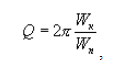
где Wк - полный запас энергии колебаний при резонансе;
Wп - потери энергии за период
[ Физический энциклопедический словарь]
2. Количественная мера потерь колебательной системы. Показывает, во сколько раз амплитуда вынужденных колебаний при резонансе превышает амплитуду на частоте, много меньшей резонансной при одинаковой внешней силе
3. Отношение резонансной частоты спектра колебаний к его ширине на уровне 0,707 от максимального значения амплитуды спектра
Примечание
Определения 2 и 3 являются достаточно точными для систем с высокой добротностью (Q >(5-10)), определение 1 пригодно во всех случаях
[Система неразрушающего контроля. Виды (методы) и технология неразрушающего контроля. Термины и определения (справочное пособие). Москва 2003 г.]
добротность (1)
коэффициент добротности (1)
-
[IEV number 151-15-45]
добротность (2)
коэффициент добротности (2)
-
[IEV number 151-15-46]EN
quality factor (1)
Q factor (1)
for a capacitor or inductor under periodic conditions, ratio of the absolute value of the reactive power to the active power
NOTE 1 – The quality factor is a measure of the losses, usually unwanted, in a capacitor or an inductor.
NOTE 2 – The quality factor depends generally on frequency and voltage.
[IEV number 151-15-45]
quality factor (2)
Q factor (2)
for a resonant circuit at the resonance frequency, 2π times the ratio of the maximum stored energy to the energy dissipated during one period
NOTE – The quality factor is a measure of sharpness of the resonance.
Source: 801-24-12 MOD
[IEV number 151-15-46]FR
facteur de qualité (1), m
facteur de surtension (1), m
pour un condensateur ou une bobine d'inductance en régime périodique, rapport de la valeur absolue de la puissance réactive à la puissance active
NOTE 1 – Le facteur de qualité caractérise les pertes, généralement non désirées, dans un condensateur ou une bobine d'inductance.
NOTE 2 – Le facteur de qualité dépend généralement de la fréquence et de la tension.
[IEV number 151-15-45]
facteur de qualité (2), m
facteur de surtension (2), m
pour un circuit résonant fonctionnant à la fréquence de résonance, 2π fois le rapport de l'énergie maximale emmagasinée dans le circuit à l'énergie dissipée pendant une période
NOTE – Le facteur de qualité caractérise l'acuité de la résonance.
Source: 801-24-12 MOD
[IEV number 151-15-46]Синонимы
EN
DE
FR
добротность конденсатора
Отношение реактивной мощности конденсатора к его активной мощности при синусоидальном напряжении определенной частоты.
[ ГОСТ 21415-75]
добротность конденсатора
-
[Лугинский Я. Н. и др. Англо-русский словарь по электротехнике и электроэнергетике. 2-е издание - М.: РУССО, 1995 - 616 с.]Тематики
EN
DE
FR
D. Gütefaktor
E. Quality factor
F. Facteur de qualité
Отношение реактивной мощности конденсатора к его активной мощности при синусоидальном напряжении определенной частоты
Источник: ГОСТ 21415-75: Конденсаторы. Термины и определения оригинал документа
Франко-русский словарь нормативно-технической терминологии > facteur de qualité
- 1
- 2
См. также в других словарях:
Maximum power — can refer to different concepts: In electronics, the maximum power theorem In systems theory, the maximum power principle This disambiguation page lists articles associated with the same title. If an interna … Wikipedia
maximum power — maksimalioji galia statusas T sritis automatika atitikmenys: angl. maximum power; peak power vok. maximale Leistung, f; Spitzenleistung, f rus. максимальная мощность, f; пиковая мощность, f pranc. puissance en crête, f; puissance maximale, f… … Automatikos terminų žodynas
maximum power — The maximum power of an engine as measured by a dynamometer … Dictionary of automotive terms
Maximum power principle — in Energy Systems Language adapted from Odum and Odum 2000, p. 38 The maximum power principle has been proposed as the fourth principle of energetics in open system thermodynamics, where an example of an open system is a biological cell.… … Wikipedia
Maximum Power Point Tracker — Un MPPT, de l anglais Maximum Power Point Tracker est un principe permettant de suivre, comme son nom l indique, le point de puissance maximale d un générateur électrique non linéaire. Les systèmes MPPT sont généralement associés avec les… … Wikipédia en Français
Maximum power transfer theorem — In electrical engineering, the maximum power transfer theorem states that, to obtain maximum external power from a source with a finite internal resistance, the resistance of the load must be equal to the resistance of the source as viewed from… … Wikipedia
Maximum power theorem — In electrical engineering, the maximum power (transfer) theorem states that, to obtain maximum external power from a source with a finite internal resistance, the resistance of the load must be made the same as that of the source. It is claimed… … Wikipedia
Maximum power point tracking — Current voltage characteristics of a solar cell at a particular light level, and in darkness. The area of the yellow rectangle gives the output power. Pmax denotes the maximum power point Maximum power point tracking (MPPT) is a technique that… … Wikipedia
Maximum power point tracker — A maximum power point tracker (or MPPT) is a high efficiency DC to DC converter which functions as an optimal electrical load for a photovoltaic (PV) cell, most commonly for a solar panel or array, and converts the power to a voltage or current… … Wikipedia
Maximum power point tracker — Un MPPT, de l anglais Maximum Power Point Tracking est un principe permettant de suivre, comme son nom l indique, le point de puissance maximale d un générateur électrique non linéaire. Les systèmes MPPT sont généralement associés avec les… … Wikipédia en Français
Maximum Power Point — Verschiebung des MPP mit sich ändernder Bestrahlungsstärke sowie Strom und Leistung im Bezug zur Spannung Der Maximum Power Point (oder kurz MPP) ist der Punkt des Strom Spannungs Diagramms einer Solarzelle, an dem die größte Leistung entnommen… … Deutsch Wikipedia
